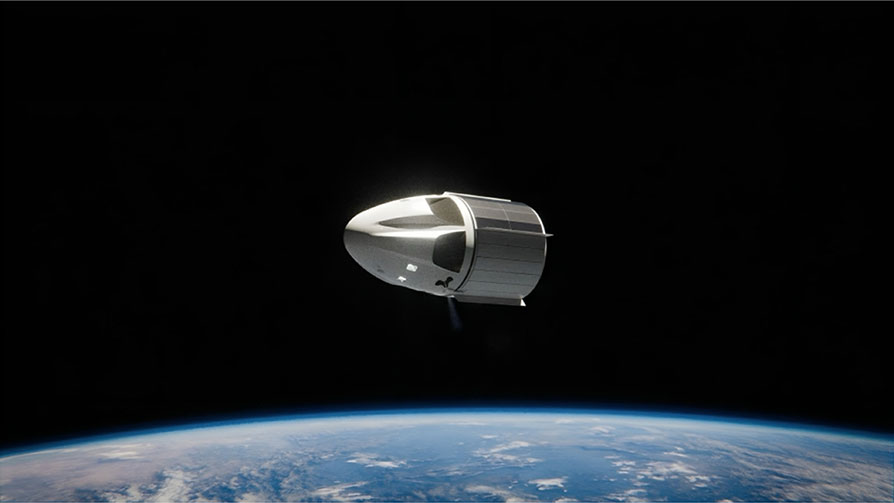
Human spaceflight in low Earth orbit is entering a new era. As the International Space Station approaches the end of its operational life, a new generation of commercial space stations is taking shape. They will need safe, reliable, and diversified ways to transport people to and from orbit.
Today, the number of countries and providers capable of transporting humans to low Earth orbit remains extremely limited. There are only three nations capable of flying astronauts to space today, and the most active commercial provider is set to retire their fleet of reusable capsules. To support a growing commercial LEO economy, additional transportation options are essential for competition and sustained access to space.
This is a global opportunity. More human spaceflight can expand what we do in low Earth orbit, from scientific research and innovation to new commercial activities, while inspiring a new generation to look to space. And as we look ahead, no space station nor the astronauts that inhabit it, should have to depend on one single company or vehicle to guarantee their access to space.
At The Exploration Company (TEC), we believe that our path to human spaceflight should start with cargo.
Cargo first
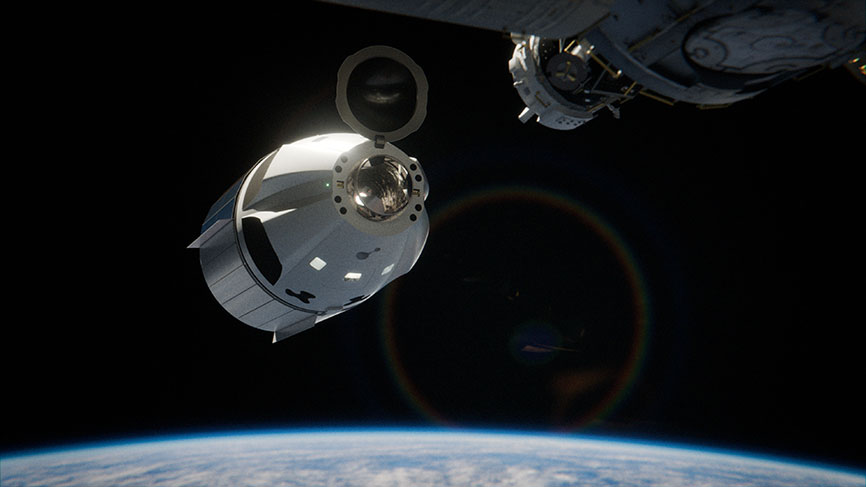
Nyx is being developed first for cargo missions to the International Space Station. But Nyx was designed from the beginning with its evolution to human spaceflight in mind.
Cargo and Crew share many of the capabilities that make a spacecraft work: propulsion, guidance and navigation, autonomous rendezvous and docking, avionics and flight software, thermal protection, re-entry and recovery.
Just as importantly, Cargo builds more than a spacecraft. It builds the teams, test infrastructure, mission operations, supply chain, markets and engineering processes that Crew can build upon.
And every Cargo mission builds flight heritage. Launching, operating in orbit, docking, re-entering the atmosphere and recovering Nyx produces real-world data that can inform the development of Crew.
Cargo is therefore not only a technical precursor to Crew. It creates a transportation business, customer relationships, and recurring missions on which a future Crew service can build.
In simple terms: “Cargo first” reduces the technical and program risk of developing Crew.
What changes when astronauts fly?
Turning a cargo spacecraft into a human-rated vehicle is still a significant engineering step. People introduce requirements beyond what a cargo only mission demands. Three areas illustrate that clearly.
- Launch abort and propulsion. A crew must be able to escape safely if there is an emergency during launch. This requires a dedicated abort capability and associated changes to the spacecraft’s propulsion and control systems. In November 2026, TEC completed the System Concept Review milestone for an ESA-funded study to define a Launch Abort System (LAS) for a capsule-based return vehicle and to prepare the next step of a pad-abort demonstration program.
- Life support. NyxCrew needs environmental control and life-support systems (ECLSS) capable ofmaintaining the safe, livable environment that people require throughout amission. From pressure regulation to air circulation and temperature control,fire detection and suppression, all the way to cabin lighting, teams across TECare already working on systems that can be reused and adapted for Crew. We havealso begun prototyping for additional human-rated life support systems,including CO2 removal.
- Flight software and human interfaces. Human spaceflight requires additional fault management and redundancy, as well as systems astronauts can monitor and control safely and intuitively. These are systems we are working on today – from rapid iteration on handheld flight controllers to digital crew interfaces for astronaut testing.
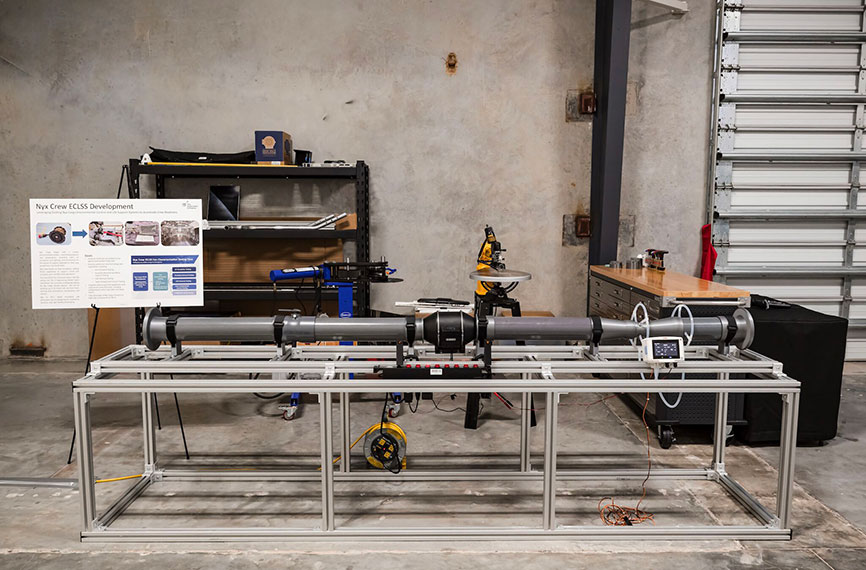
These are substantial engineering challenges. But we are not approaching them from a blank sheet of paper. The underlying Nyx platform is already being developed, and Crew-specific engineering work has already begun.
Crew engineering is already underway
At TEC's Rapid Innovation Lab in Houston, a full-scale Nyx Crew mock-up is already being used for human-factors engineering. Equipped with seats, active displays and controls, it allows engineers and astronauts to test and iterate how people will interact with Nyx during flight.
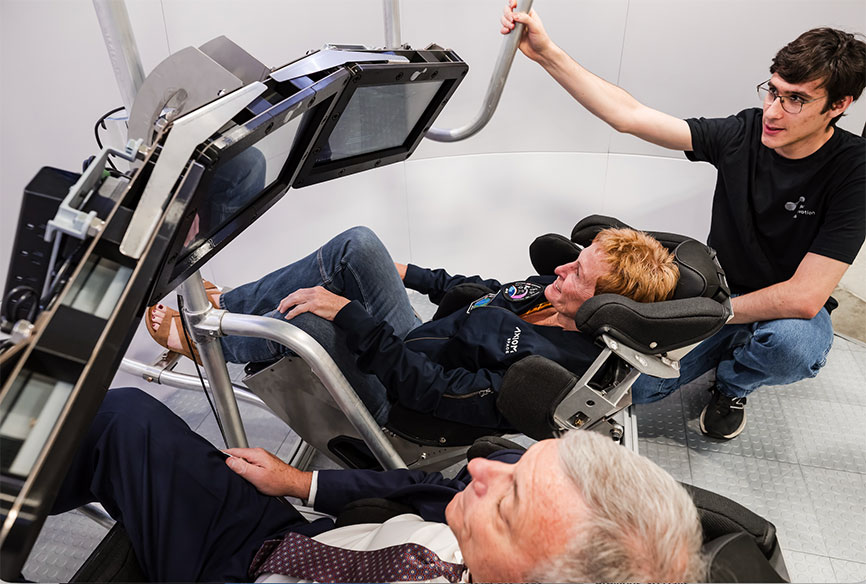
The wider team brings experience from human-spaceflight programs including Orion, Dragon, CST-100, Starship, New Shepard and the ISS.
As part of the work on launch abort systems for ESA, TEC is assessing what modifications will be needed for Nyx Crew to ensure the safety of the astronauts during an abort. This includes modeling the function of propulsion and guidance systems, evaluating primary and secondary structures, as well as assessing recovery scenarios and landing zones under a range of conditions.
That work runs in parallel with Nyx Cargo development. The principle is straightforward: mature the common platform through Cargo, while developing and testing the systems that are specific to people. Over time, those two paths come together in an integrated Crew vehicle.
A new model for human spaceflight
There is another reason this moment is different.
Historically, developing crew transportation has required governments to fund enormous programs almost entirely themselves. The new commercial space economy creates another possibility: public institutions can provide anchor demand while private companies and investors commit their own capital, technology, and risk.
That model becomes possible when the vehicle is designed for a global market rather than a single institutional customer: commercial stations, space agencies, and international partners will all need reliable crew transportation.
The prize is bigger than one spacecraft. Human spaceflight pushes the boundaries of science and technology. It develops expertise, strengthens industrial capability and creates highly skilled jobs. Above all, it gives more people, researchers, and organizations the ability to push humanity forward in space.
The road from Cargo to Crew will take time, testing and engineering iterations. But we have a strong start with Nyx, and with the spacecraft, teams, infrastructure, and flight heritage we are building today.
Media Kit