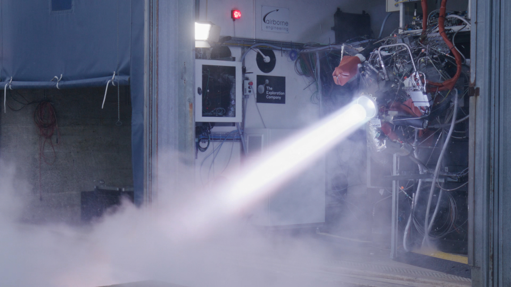
Launched in 2022, The Exploration Company’s Huracan program is developing a reusable cryogenic LOX‑methane engine for lunar landers and cislunar transport vehicles. The engine delivers 15 kN of vacuum thrust using an e-pump cycle, designed to land The Exploration Company's future lunar vehicles on the Moon, and then restart for ascent or orbital rendezvous.
Backed by the European Space Agency Huracan Step‑2 contract, The Exploration Company advanced from component testing to system‑level hot‑fires in early 2026. Over a seven-week campaign at Airborne Engineering Ltd. in Wescott, UK, the team successfully completed 26 firings that accumulated 375 seconds of run time while exercising the full throttle range and multiple restarts.
Development Model 1 (DM1) Test Campaign Results at a glance
· 26 hot‑fires — 375 s cumulative burn‑time in seven weeks.
· Longest single burn 53 s at up to 100 % throttle.
· First European methane E-pump fed engine to complete flight‑like throttle sweeps 50–100% on a single campaign.
· Dedicated electric oxygen pump test campaign with a total operating duration of 371s in LOX.
A campaign built for speed and adaptability
Working in close partnership with Airborne Engineering Limited in the UK, the Huracan team moved quickly and adjusted their approach based on results from each test.
Fast ramp-up: From assembly in Bordeaux, shipping to the UK, integration to the test facility, to the first cold flows, less than 4 weeks passed. Followed by 4 weeks of hot fire testing.
Closed-loop control: Unlike open-loop operation, which follows pre-defined commands, the system adjusts in real time using sensor feedback to maintain target conditions. Developed for more than a year and integrated from the start of the campaign, it enabled stable mixture ratio and chamber pressure control across runs.
Two engine configurations: As part of the campaign, the team compared the performances of two distinct injector head and main chamber variants.
We go further together
Beyond the immediate team in the control room for test firings, a crew of more than fifty teammates across propulsion, software, AIT (Assembly, Integration & Testing), logistics and manufacturing helped the team reach test readiness: machining hardware, refining control loops, arranging late-night shipments. Team members from various backgrounds and countries worked together to deliver the right fix, file, or part exactly when needed.

The engine awakes – from cold flows to hot fires
DM1 successfully logged twenty-one cold-flows spread across liquid nitrogen, liquid methane and liquid oxygen, followed by twenty-six hot-fires. Total engine run time reached 375 seconds. Multiple test runs at more than 50 seconds (with the longest single burn at 53 seconds), only limited by the capacity of the run tanks, delivered the thermal, structural and control data needed for DM2, the next key test campaign planned for Huracan.
Push limits, test fast, learn fast
Over the course of the campaign, all components were intentionally pushed to and beyond their design limits to fully characterize performance and durability.
While all systems demonstrated robustness with minimal wear, the final test day provided a particularly valuable data point. After more than 100 tests, and a cumulative runtime of more than 20 minutes in liquid nitrogen and liquid oxygen conditions across three campaigns, the oxygen pump reached its operational limit.
This outcome is fully aligned with our “test fast, learn fast” philosophy. The team is actively investigating the root cause and leveraging the data to further strengthen the design. Such moments are a critical part of development, allowing us to continuously improve performance, reliability, and confidence in the system.
Next on that road: Development Model 2 (DM2)
The Exploration Company is currently building a dedicated facility to further test and qualify Huracan in Bordeaux. In early 2027, a flight-representative engine fitted with a heat exchanger, inverter, and engine control unit will be put to the test in these new facilities.

.webp)
.jpg)
.avif)