The Exploration Company awarded InSPoC-1 Phase B2 and selected for phases B2-C-D-E to advance European in-orbit docking, refuelling, and interface standards.
The Exploration Company (TEC) announces the award and contract signature with European Space Agency (ESA) of In-Space Proof-of-Concepts 1 (InSPoC-1) Phase B2 and its selection for subsequent definition phases C, D, and E Within ESA’s programme for future space transportation, FLPP. This marks an historic milestone toward European routine, commercial in-orbit operations in Low Earth Orbit (LEO). Building on Nyx, TEC’s modular orbital vehicle currently progressing through NASA’s certification process for docking with the International Space Station, InSPoC-1 broadens the company’s offer into commercial in-orbit services by demonstrating prepared and collaborative docking between two commercial spacecraft and the transfer of storable propellant.
The Exploration Company leads a European consortium that includes Thales Alenia Space, GMV, SENER, Almatech, and CDS. The InSPoC-1 mission scenario pairs TEC’s Oura spacecraft with a targeted cooperating LEO client spacecraft, enabling a representative end-to-end demonstration of cooperative rendezvous, docking, refilling, and power and data exchange.
Phase B2 focuses on raising to Technology Readiness Level (TRL) 6 the technologies required for safe and repeatable operations between two spacecraft.
The work program includes:
- Safe rendezvous and proximity operations to enable cooperative and prepared docking
- Demonstration of non-cryogenic propellant transfer between two LEO spacecraft
- Power and data transfer across a docked configuration
- Operational procedures, autonomy, and Fault Detection, Isolation, and Recovery (FDIR) tuned to mission safety and repeatability
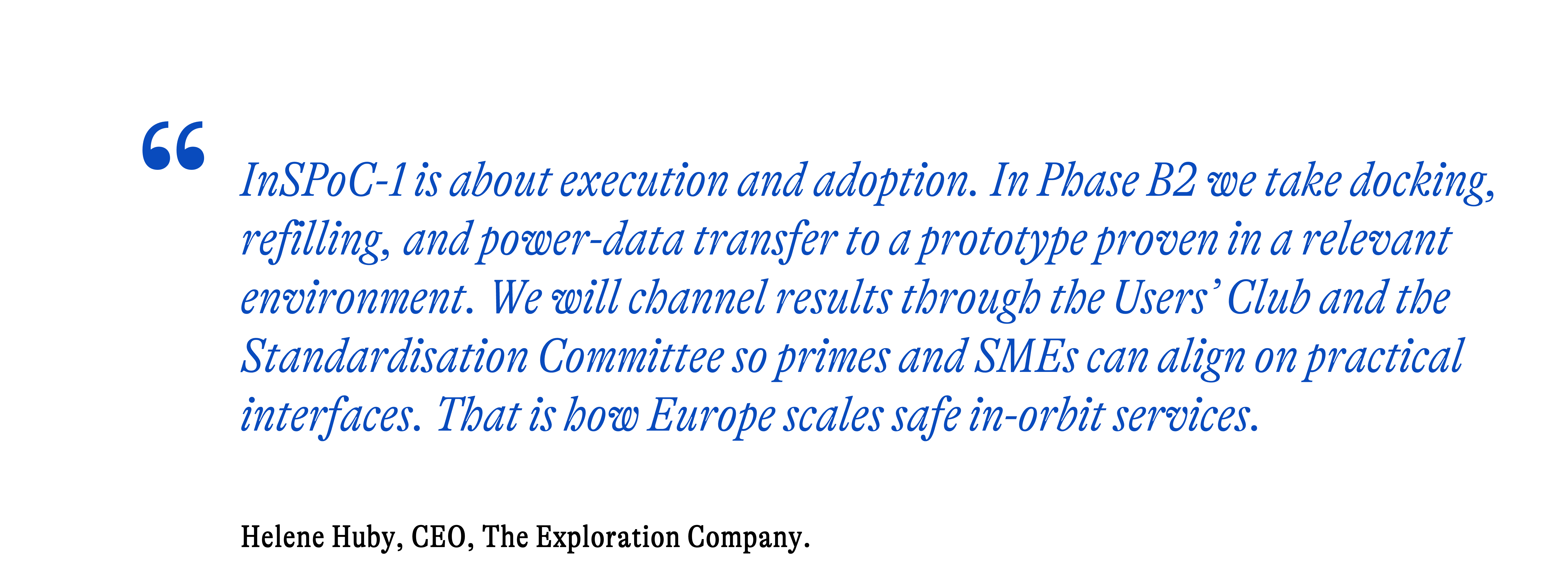
InSPoC-1 also includes structured engagement with European industry through a Users’ Club and dedicated working groups to converge on baseline European interfaces. Priorities include a passive docking interface compatible with European active docking subsystems and a reference RPOD sequence that supports safe multi-provider operations. Draft baselines will be shared during Phase B2 with the objective of easing adoption by European space prime contractors and accelerating the path from demonstration to operational services.
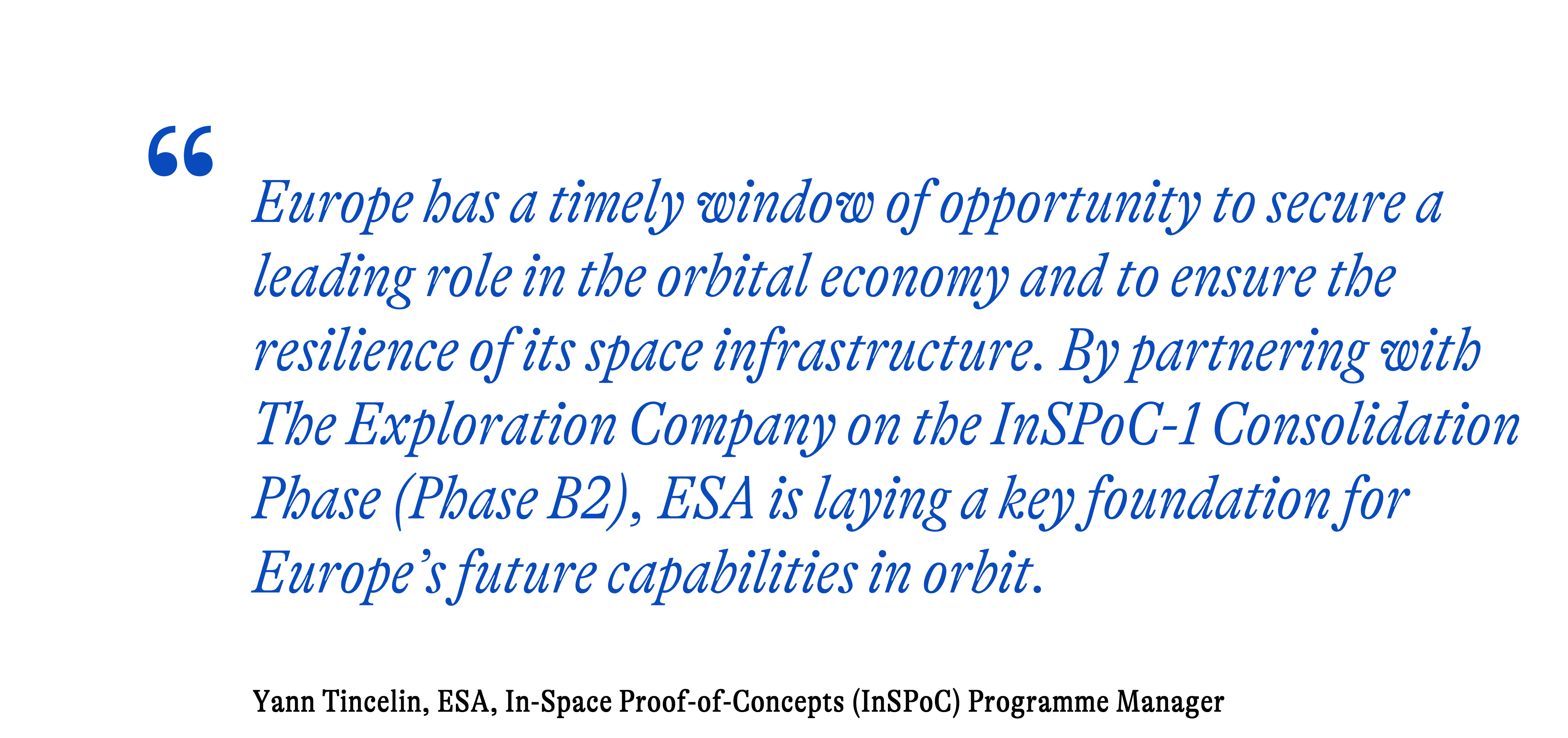
The Exploration Company views InSPoC-1 as an enabler to develop European solutions for the commercial in-orbit services market and as a foundation for dual-use scenarios where the same technologies support governmental applications. Precision Rendezvous, Proximity Operations, and Docking (RPOD), cooperative docking, non-cryogenic refuelling, and robust power and data interconnects contribute to resilience, mission flexibility, and European autonomy in orbit.
Media contact:
media@exploration.space

.webp)
.jpg)
.avif)